Tuesday, February 16, 2016

Architecture Tests


Created some example concepts for what the architecture in my designs could look like. These were based off the existing studies done on the architecture and environments in the case studies, and in ancient Asia. Doing these tests meant I had a basis to build concepts on, drawing influence from the materials studied in co-ordinance with the criteria.                                                                           
Above  - Loose tests for environment piece, using the colour palettes gathered from the Water Tribe during Avatar: The Last Airbender analysis. 
This was dropped as part of the iteration process, as it seemed one of the weaker designs, and I was unsure how I could further include aspects of inspired Asiatic visual vulture. Further line and shape tests were made to further analyse the structures of ancient Asia, and concept sheets were made of my own concepts, imbued with this newly gained visual culture knowledge.


These are the architecture designs created, inspired from the studies on existing Asiatic and Middle-Eastern architecture. I was fairly happy with these, as I feel they display not only unique visual culture, but one that is reminiscent of the cultures I have studied to create them.
Taking these further, i'd like to take the stronger designs and create full turn-around images. I feel that some of the concepts would benefit greatly from a third dimension, and this may also help with scale. Small humanoid figures were added for scale, as many of these buildings were based on the tall stacked towers observed in the previous research. As well as this, influence was drawn from the previously created Sparth analysis diagrams, as I tried to keep the shapes simplistic, clean and effective.


The designs were coloured and textured using palettes and textiles created whilst analysing case studies and practical research. I tried to vary the textures and hues used in each design to allow for a wider range of unique designs to be made. 


Character Design Reflection 


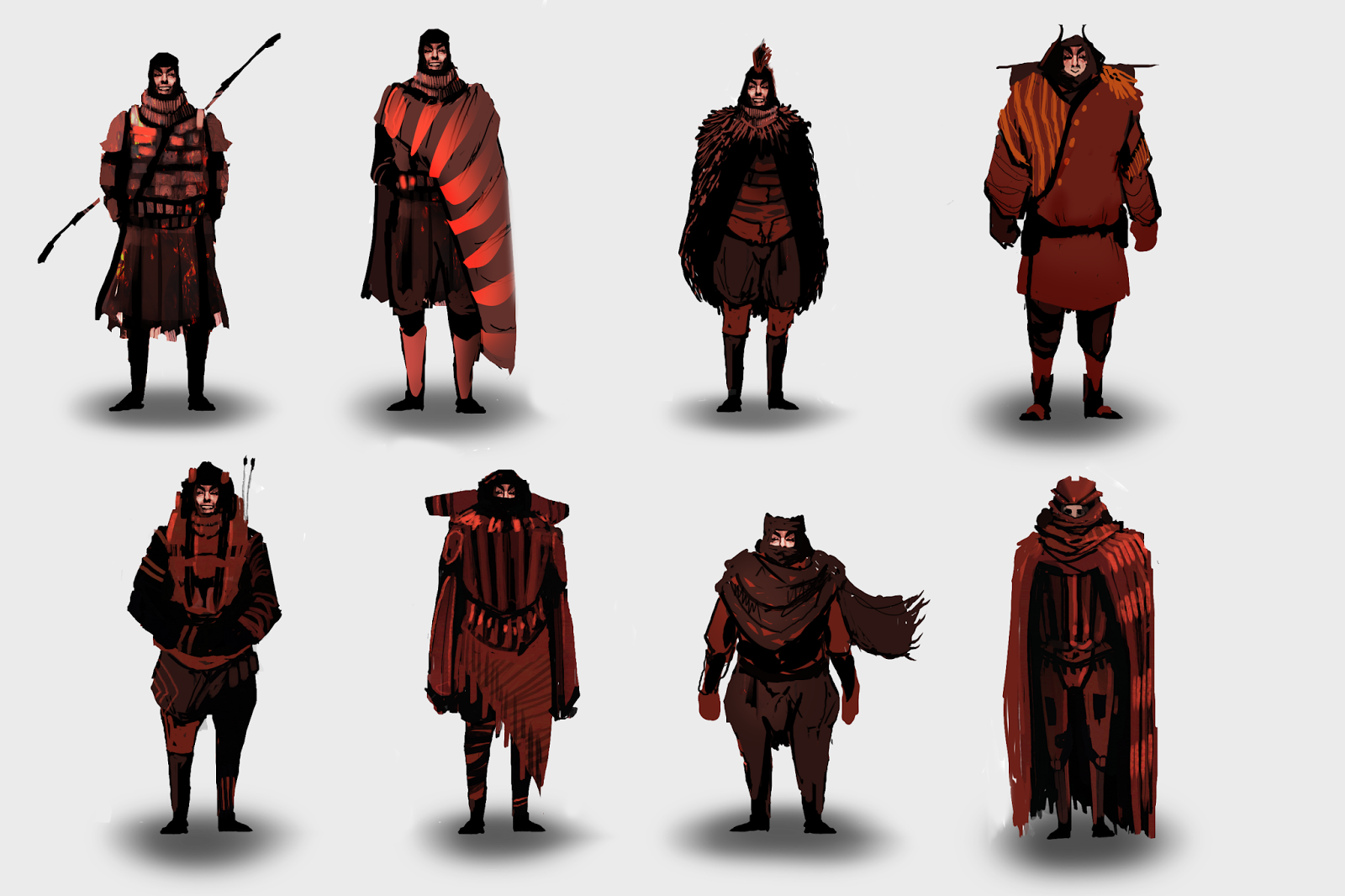
The above two images are boards of original character and costume designs, based on the studies previously created whilst analysing Asiatic visual culture and the case studies, particularly the Han Dynasty period. I am fairly happy with this outcome, as they appear to be the strongest character designs I have created yet! The colour palettes were heavily reds, oranges and blacks, as was the colours predominantly used in the cultures analysed. The use of Han-Dynasty costuming added a new layer of visual culture to the character designs, as well as suggested detail and personality. In particular, I like the second board, top right image as a character design and outfit. The form reads well, and is an effective example of the utilization of non-western influence in my own concept design.
The weapons on the characters person are typical staffs and spears used in Han Dynasty China, with some twists such as rifles and other details added to add my own flair.

For next steps, I will take the chosen figures and create turnarounds from them, or using them as smaller scale objects in larger concept pieces.


Avatar: The Last Airbender Analysis

Avatar: The Last Airbender is an American animated series featured on Nickelodeon from 2005 to 2008. The series is heavily inspired by Eastern Asian mythologies, in both visual design and plot/lore. Avatar was highly popular in the West, due to it's fantastical Asiatic style combined with relateable, western characterisms.
The show is set in a semi-magical world in which some characters can physically manipulate the elements using various forms of Chinese martial arts, this is known as bending.

The four prominent nations in Avatar are Earth, Water, Fire and Air. The idea of a set number of elements is popular in both Indian and Asian mythologies.  

Each elements "benders" use martial arts techniques based in existing fighting arts methods.

The fire nation use Kung Fu.
The earth nation use Hung Gar.
The air nation use Baguazhang, or "circle walking"
The water tribe use Tai Chi.

Costume:


Each nation features a bold and noticeable colour palette, allowing for the different cultures within the Avatar mythology to be distinct and individual.


Architecture/Environment

Avatar: TLA infuses it's environment with Asiatic visual culture, creating a unique yet familiar setting and mythology. There are many structures and locations within this series that are directly inspired from existing structures.
For example, the Air Temples in the series are very similar to the Temples of Bhutan, a real-life mountaintop temple.


These are costume studies created whilst analysing the materials provided by Avatar research. Each outfit is based on the various real-life Asiatic costumes represented in Avatar. These serve as both practical analysis and a good basis for designing costumes for the project.

Tuesday, February 2, 2016

Asiatic Architectural Analysis


                             Asiatic architectural analysis


After gathering various resources from books/historical articles, I used the information present to create a list of criteria which specifically detailed the recurring visual design factors of ancient Asiatic architecture. Using this list, I can give myself specific criteria in order to accurately draw inspiration from when creating designs. Some of these images were harder to research, as many of the ancient Chinese architectural structures were destroyed long ago. This was predominantly due to the beams and structures being made of timber, which is vulnerable to many of the elements.

Stacking, wooden-framed buildings (Lou):

These are predominantly composed of large column structures, often stacking and replicating many stories high. These are often broken up by pavillions and protruding ledges and rooftops.
The walls in-between these floors are permeated with doors, gates and windows.

Pavillions (Ting):

Chinese pavillions were usually made from wood or bamboo. These were built in various scales and shape, all of which feature large columns and no exterior walls.

Curved awnings/rooftops:

The true purpose of the Chinese tradition of curved roofing is often debated, and is unknown. However, the most accepted theory lies in the historical evidence that Buddhists believed that curves warded off evil spirits, which are imprisoned to move in straight lines. The curved rooftops were a spiritual safeguard to ensure that when evil spirits fell to earth, they would be fired back into the air.

Religious Architecture:

Buddhist architecture often featured large humanoid statues depicting deities such as Bodhisattva. Many asiatic temples had large courtyards filled with Buddha statues.


Character Analysis:


After gathering various resources from books/historical articles, I used the information present to create a list of criteria which specifically detailed the recurring visual design factors of ancient Asiatic clothing and uniform. Using this list, I can give myself specific criteria in order to accurately draw inspiration from when creating designs.


Hanfu (Hanzuang)

This is an essential silken robe worn by most of the Han Dynasty people. 
Usually resting around the knees, the Hanfu consisted of a tunic, an ankle-length skirt and was often tied with a rope or sash. As the class system developed, the length of the Hanfu became a measure of wealth and power. Men and women of higher class would wear longer, loose-fitting sleeves and adorn their robes with jade ornaments.

Above: Character clothing model created to represent the most common styles of clothing throughout Han Dynasty China.


Headwear

Headwear was often a method to show social rank in Han Dynasty China. Each social class had their own styled headwear from soft caps (mao) to more formal headdresses (guan). 


Pattern

The patterned textiles found throughout the Han Dynasty were all created through various means of loom. This means that there are certain significant patterns that repeat throughout a lot of ancient Asia due to this method of production. 

Popular loom patterned used throughout Han Dynasty China

Various gathered reference of textiles used during the Han Dynasty.
Predominant colours are gold, red and orange.


Tuesday, January 26, 2016

River Process

Studies were made of cliffs and landscapes commonly occurring in Asiatic landscapes.  From this cliff/lakebed study, it began the idea process which later resulted in a full concept piece. 


A rough concept thumbnail was made utilizing photobashing and loose colour techniques. This was based on the previous thumbnails created and was chosen for higher polish. I tried to replicate the feel of the dense forests found in Asia, as well as using the tree and rock studies created to enhance the piece. Using the critical framework for the research, following the fundamental development techniques to produce pipeline-efficient work.


Higher polish, beginning in greyscale to build values and scale. The 2 headed giant idea was inspired by the original Jack the Giant Killer tale, which features a wide range of humanoid giant concepts, most of which have multiple heads. I tried to create a sense of density and humidity, using the light reflecting from the lake to generate atmospheric mist and spray.


Using the greyscale image as a template, I applied colour via various layer settings and adjustments. This is one of the many ways I can generate images, but I used this method in particular in order to preserve the values and depth necessary to sell the atmosphere. The bridge used in the midground was inspired by traditional Chinese cantilever-style bridges, and was lit particularly to show this.  I tried to lead the viewers eye with this piece, placing the character at the front, leading the eye around the treeline or along the river to the Giant silhouette. A regret of mine here was leaving the giant's figure lesser detailed, as looking back I can see where I might've added additional detail. However, the fog and silhouette adds a certain sense of looming dread, so it works.
Below - Cantilever-Style bridge


Tuesday, January 19, 2016


Above - A study of some Middle-Eastern ruins for practice, and 2 possible thumbnails for further development based on Asiatic architecture.


World Of Warcraft - Mists Of Pandaria Analysis

World of Warcraft: Mists of Pandaria is the fourth expansion for the MMORPG World of Warcraft.
The new Asian-themed expansion introduced a new land to explore, a new player class and a new playable race, the Pandaren. Every aspect of the expansion is imbued with cultural inspiration from ancient China and Japan, from the Pandaren's Buddhist views and attitudes to the lush landscape of Asiatic rolling hills and willow trees. In order to understand how visual culture can be depicted in this example, character and environment areas have been broken down into key visual factors;


The Pandaren are a race of giant, humanoid Pandas native to Pandaria. They are seen as the game's first neutral race, where a player can choose their allegiance as a Pandaren. The Pandaren lore is influenced greatly by Asian cultures, and this is depicted visually in their armour and costumes, as well as their character traits.  


 Many of the NPC characters tend to wear silk robes and rice farmer hats, or sport hairstyles commonly wore in ancient Asiatic times. The jewellery and accessories adorning the characters are also heavily imbued with Asian culture, often depicting leaf symbols, crafted from Gold and Jade. Both of these materials were commonly used in the crafting of ancient Asiatic armour.
One of the first locations that a Pandaren player will encounter is the Wandering Isle. This lush valley contains many architectural elements which are directly inspired by real-world designs.
Many Asiatic motif's occur here, such as curved roof beams, gold inlay and red decorum. Pandaria features many rolling landscapes, lush forests and cloud-ringed mountains, all elements commonly found in traditionally Asian environments and landscapes.  


Wednesday, November 11, 2015

The Four-Tierred Class System of Feudal Japan - Visual Breakdown

The era in which I draw most cultural influence for this project is Japan. In particular, between the 12th and 19th century of feudal Japan, where the elaborate tier system divided the people both structurally and aesthetically.  I decided to study this region in particular based on the wide diversity of influence and visuals available. In addition to this, I believe this era of Japan has the strongest recognizable shape language, which makes for strong concepts.

On beginning this research, I realised just how vast the Japanese Feudal era really was.
The below pyramid represents the complex hierarchy in which this era adhered to.


This is a fairly extensive list of classes, so below I have collated each individual class into a more manageable 4 categories. For aesthetic reasons, the highest rank I am researching at the moment is samurai. The reason being that the character I am designing will not be an emperor, shogun or daimyo, as Jack is seen to be of average to poor in status, ranging from variations of the Giant Killer tale.


Samurai

Samurai and their Lords (Daimyo) wielded vast power and wealth, thus are the highest class in feudal japanese society. Each Daimyo would own an area of land, and an army of samurai to command. These samurai would answer only to their Daimyo, and this lord would only answer to their military leader, a Shogun.

Visual Aspect:

Samurai would traditionally wear wide-legged pants known as Hakama. First worn by samurai horseman in order to protect their legs. They are similar to the wide leather pants worn by cowboys, but made from thick fabric. Hakama were originally used as functional armour, but later were worn as a sign of status to distinguish those of power.
The samurai often wore a long jacket known as a Kataginu. These were long sleeveless jackets with padded shoulders, and this ensemble was often completed with a silk cord belt.


Famers/Peasants

Interestingly enough, below the Samurai in this tier system are the farmers and peasants. They were considered an honoured class, as they supplied every class with the necessary food and supplies to live. Despite this, farmers were taxed hugely by their lords for most of the era, often not being permitted to consume their own produce.

Visual Aspect:

Despite being a valued class, farmers and peasants predominantly wore rough wool or linen. These were often handmade, and served as their primary item of clothing every day. Men wore tunics and long stockings, usually red, brown or grey in colour. In colder months, they would wear cloaks made from leather and wool, or a large rice straw poncho known as a Mino.


Artisans

Artisans produced many necessary goods including clothing, cooking utensils, farm tools, and ship anchors. Even the prestigious swordmakers who were charged with forging powerful samurai blades were considered below farmers and peasants.

Visual Aspect:

The artisans wore similarly styled clothing to peasants, basic kimonos made from rough wool or linen. Like the farmers, artisans were valued for their work but not paid as so.

Merchants

Unlike our current society, merchants were considered the lowest of the tier system. Merchants were often hated for their self-beneficial traits, often profiting from the artesans and peasants above them. Merchants were forced to live in a separate area of the city, and were forbidden to interact with any of the other class tiers on subjects that did not contain business.

Visual Aspect:

Dark coloured kimono similar to peasants and artisans.


Character design studies were created from these findings. They combine the newly utilized visual culture knowledge and my own personal character style to create new and interesting designs. These concepts will then be taken forward for use in higher-polished concept work, or used to create character turnarounds.

Cultural Appropriation and the Arts - James Young

Whilst searching for materials in my field, I discovered an interesting journal by James Young.

What is a culture?
Young attempts to explain the essence, of culture, and leads with saying it is "a set of beliefs, achievements, customs and so on that is characteristic of a group of people".

Artists are constantly pulling from cultures outside of their own for inspiration and design elements.
Traditional painters such as Picasso have used motifs which originate in African carvings. Musicians are notorious for borrowing and appropriating jazz and blues styles originally developed from African-American culture. For years, the film industry has attempted to do the same. Dreamworks' Road to El Dorado and Disney's Pocahontas are prime examples for these.

These examples of cultural appropriation and others alike have sparked controversy throughout all media platforms. There are both ethical and aesthetic issues that occur when cultural appropriation occurs as an art form. It can be argued that to produce art through cultural appropriation is immoral, as stereotyping can occur, as well as misinterpretation of the original culture.

"The aesthetic failure of certain artworks may cause them to be wrongly harmful to members of a culture. (The work may, for example, misrepresent the originating culture in a harmful way.)" However, many acts of this can be seen as honoring culture, resulting in artworks of value.

This is relevant to my area of research, as through practical methodology I shall be taking influence from non-western cultures to inspire conceptual development pieces. It is important that the work produced is not ethically offensive, which could occur through visual stereotyping. In addition to this, it will also be important to consider the design from a researched and learned standpoint, as Young stresses the importance of accurate representation, and discusses the Cultural Experience Argument.

This argument is based on the premise that in order for an individual to successfully appropriate a cultural style, the artist must have experience as a member of this culture. Young explains this view as "living as a member of a given culture is the necessary condition of being able to create successful works of the types developed by the culture". A harsh argument from an artists point of view, as if true it would essentially limit their creative content to whatever local culture was available.  This point of view is often found in the music industry, with the argument that a musician cannot properly learn the blues unless they experienced the lifestyle of black men in America. Young quotes the blues musician LeRoi Jones; "the idea of a white blues singer seems an even more violent contradiction of terms than the idea of a middle-class blues singer. The materials of blues were not available to the white American".

Whether this argument holds true is based solely on opinion, at least in the concern of musical taste. Whilst it is true that blues originated in African-American culture, does this limit the success of blues musicians beyond this culture? The Cultural Experience argument appears to agree with this. It is true to say that blues music originated from the slavery and eventual freedom of black slaves. These songs and this style of music was created as a response to the experiences of this men.

The Cultural Experience argument concludes that artists (at least in the music realm) who do not have the experience or previous knowledge of a culture are almost certain to produce works of poor quality. Jesse Steinberg in his book "Blues - Thinking Deep About Feeling Low", states that "blues as a whole has become "diluted" under the influence of it's white consumers and performers", which further backs up the Cultural Experience Argument as far as blues is concerned. It seems that the cultural appropriation of blues music is less about the finished product (whether the song is harmonious or dissonant), and more about the origin and experience of the artist. It is hard to apply this argument to further subjects, as it condemns the vast majority of artists who draw inspiration from foreign culture. Simply because an artist is not from a particular culture, this does not necessarily have any condemning factors in their ability to create beautiful work.

Young goes on to discuss two methods of cultural appropriation, innovative and non-innovative appropriation. In simple terms, innovative cultural appropriation draws inspiration from a style without obvious replication. It is to draw influence and knowledge from a culture, and use aspects to improve the work being created. Bluntly replicating a culture that is not familiar or known to the artist can result in non-innovative appropriation, and can be received negatively. "We would have an example of such appropriation if an American performer were to attempt to enter into the tradition of Japanese epic ballad recitation by chanting (in Japanese) the Tale of the Heike while accompanying himself on a biwa" This ties in with my previous post on stereotypes.


Visual Culture Studies Journal: http://www.sagepub.com/sites/default/files/upm-binaries/28934_Smith___Introduction.pdf

Cultural Appropriation and The Arts - James Young file:///D:/Cultural_Appropriation_and_the_Arts.pdf

Thinking Deep About Feeling Low: https://books.google.co.uk/books?id=ZT0dUgzmtL4C&pg=PA162&lpg=PA162&dq=white+people+can%27t+play+blues&source=bl&ots=1yq7RkxRDd&sig=Wm6RpPM8N1HHdSVaHJTqm9KuFmw&hl=en&sa=X&ved=0CCcQ6AEwAjgKahUKEwiwrdq3honJAhXB0h4KHRmsAn4#v=onepage&q=white%20people%20can't%20play%20blues&f=false